If you’ve ever noticed an unexpected pressure drop and spent some time searching for a non-existent leak, you’ve probably been fooled by the adiabatic effect.
The adiabatic effect is the change in temperature of the media within the system and it happens because of the direct relationship of pressure and temperature. As pressure increases, temperature also increases. In the same vein, as temperature decreases, pressure also decreases. This effect is particularly noticeable with liquids such as water or hydraulic fluids. For example, as the liquid is compressed on a hand held hydraulic pump, it quickly heats up. But once you reach your pressure point and stop pumping, the liquid immediately starts to cool and the pressure also drops. Users often think that pressure drop means the pump is leaking when in fact the liquid inside is just cooling back to ambient temperature, causing the corresponding pressure drop.
A Simple Solution for Calibrating with Hydraulic Hand Pumps
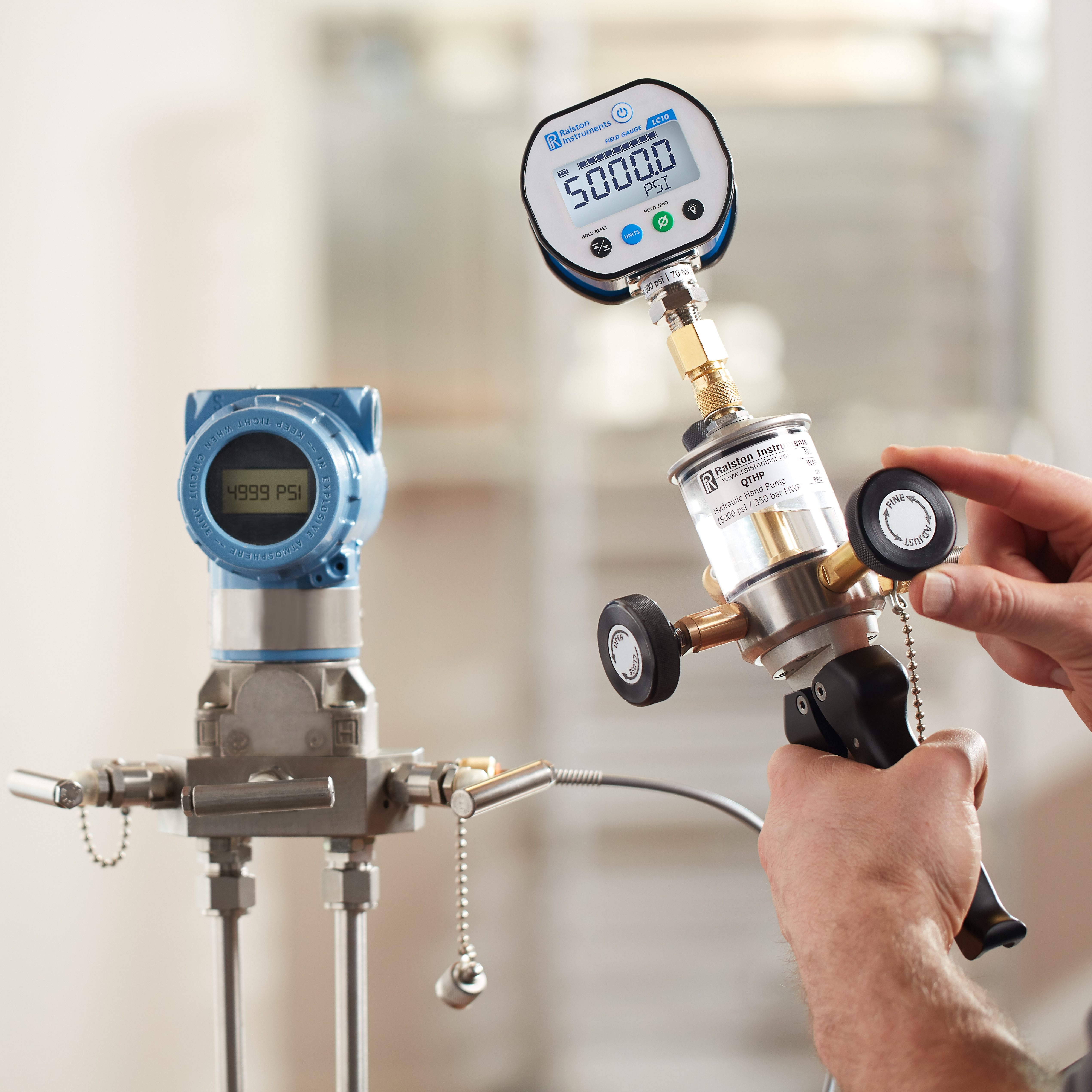
We offer two exceptionally precise hydraulic pumps with features that let you easily manage the adiabatic effect. When using either a Ralston QTHP or XTHP hydraulic pump, we recommend pumping up to the first setpoint and then pausing to let it stabilize. The pressure will drop 10 to 20% below that point as the liquid cools. Then, using the fine adjustment piston, bring the pressure back up to the set point. Because the fine adjustment piston compresses liquid more slowly, the adiabatic effect will be much less dramatic with a smaller decrease in pressure. This may need to be repeated three or four times if the pressure is being increased from 0 to 5000 or 10,000 psi. Another thing that minimizes the effect is to start with zero pressure and increase to the lowest set point first before working your way up to the higher set points. Going immediately to the highest setpoint from zero would produce the most dramatic adiabatic effect.